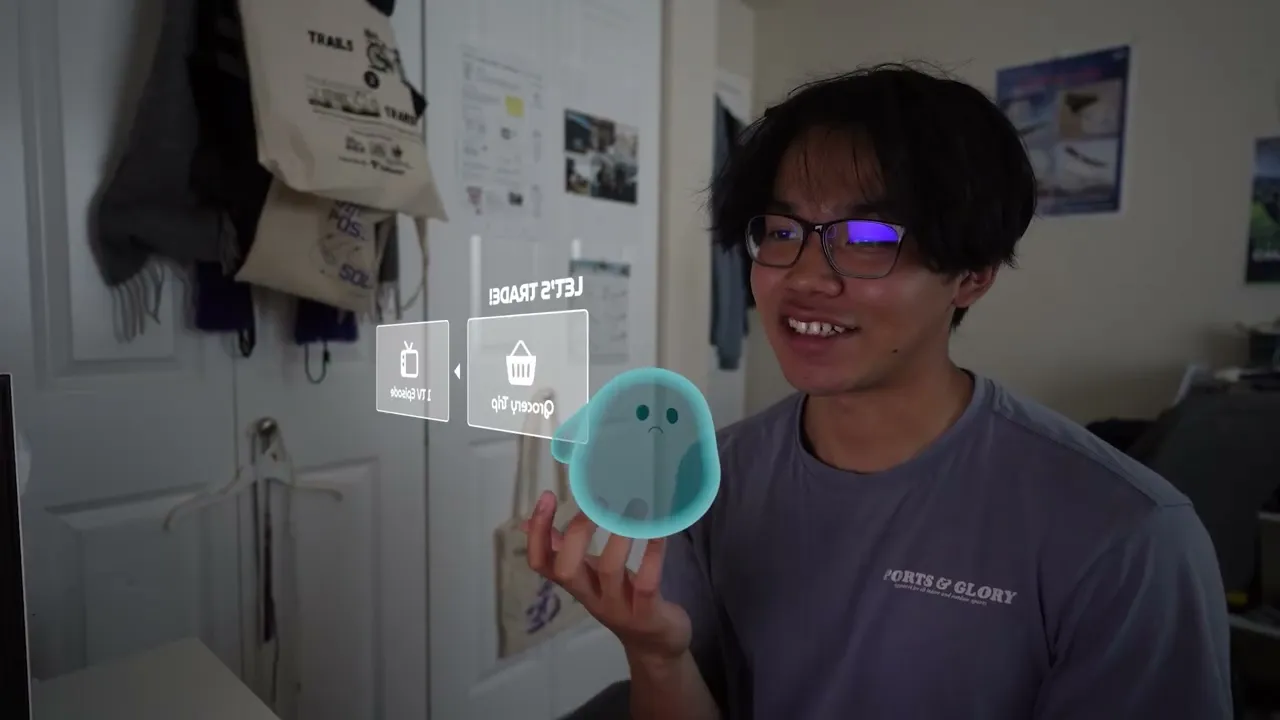
A floating, context-aware AI/AR task buddy that streamlines & gamifies daily chores & tasks using gesture & voice interactions.
SKILLS
ARTIFICIAL INTELLIGENCE DESIGN,
AUGMENTED REALITY
TOOLS
ILLUSTRATOR, AFTER EFFECTS,
PREMIERE PRO, BLENDER
TEAM
DANELLA LEI, FARREL SUDRAJAT,
& TAM TRAN
ROLE
UX & VISUAL DESIGNER
VIDEO PROTOTYPER
TIMELINE
5 WEEKS - 2025
PROBLEM
Empowering individuals to overcome chronic digital distractions and task friction to maintain long-term sustained focus
Individuals are expected to manage heavy workloads and deep-focus tasks independently. However, digital environments saturated with interruptions make starting and sustaining attention intensely complex, leading to last-minute scrambles and burnout.

SOLUTION
Lumi, your context-aware AI productivity partner for organization, sustained motivation, and accountability.
KEY FEATURE 1
Visualizing your tasks in the physical world
Lumi syncs with your calendar and scans your physical space to automatically surface the tools you need, turning intent into action instantly.
KEY FEATURE 2
Sustained focus through adaptive immersive action
Lumi tracks your deep-work streaks and rewards sustained focus with immersive, spatial mini-games that turn your task into an engaging challenge.
KEY FEATURE 3
Real-time accountability & task bargaining
Lumi monitors your focus in real-time to spot distractions, offering smart, negotiable tradeoffs that help you balance what you want to do with what you need to get done.
RESEARCH OVERVIEW
”
Sometimes I just stare at Canvas . . .
and I don’t do anything.”
Bao, 18, Student
Many solo workers struggle to maintain focus and intrinsic motivation on their own, especially in digital environments saturated with heavy distractions. It's essential that users have the right support to overcome task friction and stay engaged, reducing the risk of procrastination and burnout.
USER INSIGHTS
I conducted interviews with students to understand key pain points
After analyzing our user interviews, we uncovered the primary obstacles people face when trying to focus. Before building our solution, we needed to define what users truly lacked: structured, personalized motivation that turns deep work into an engaging experience.
#
1
Overcoming friction
Starting tasks feels overwhelming when projects appear too large or unengaging.
#
2
Meaningful progress
Sustaining deep work requires experiences that feel rewarding, fun, or competitive.
#
3
Minimizing distractions
Everyday digital interruptions make it hard to maintain sustained concentration.
XR CONSIDERATIONS
Designing for the realities of additive light in passthrough displays
Designing for passthrough displays required a strict color palette to ensure legibility against real-world backgrounds. As a first-time spatial project, it also taught us critical lessons in UI ergonomics.

RESEARCH QUESTION
How might we transform solo work into a motivating, rewarding experience that naturally curbs distractions and sustains long-term focus?
MARKET ANALYSIS
Analyzing existing task apps and Pomodoro techniques to reveal why standard checklists lack true emotional accountability
While traditional apps like Todoist and time-management methods offer basic structure, they fail to drive real action. True motivation requires emotional stakes, much like Cooking Mama, where immediate, expressive reactions to mistakes create powerful engagement.


Traditional apps offer basic structure

Expressive reactions motivates action
IDEATION & EVALUATION
We rapidly generated 27 diverse concepts and utilized a custom criteria matrix to grade each concept and filter our top design directions
To explore the design space, our team rapidly generated 27 concepts, spanning everything from intense
motivators like a virtual jail to gamified pet care. We then evaluated every concept against a strict 0-3 scale to different criteria, allowing us to objectively narrow down our top contenders for storyboarding exploration.
TOP RANKED DESIGN DIRECTIONS

Game Buttons “START”
A Floating START button exists with you,
and every time you want to start a task you
press it to start a timer
#1

Leaderboard/Game Metrics
Gamifying the tasks experience by providing personal task-related metrics and leaderboard system to push yourself to beat your high scores.
#4
+

Come On, Slowpoke
A stylized twin avatar literally runs ahead of you on a timeline or digital treadmill. Every task you complete pushes you closer, and every week we recap your total of wins (marathon to a finish line)
#21

Virtual Pet
Your task is broken up into chunks. Each chunk is one of your virtual pet’s limbs. Slowly construct its body to see which animal it is. Keep it alive by finishing tasks--if not it wil die. Make a collection as you complete more tasks?
#13
CONVERSATIONAL ARCHITECTURE
Engineering a comprehensive user flow diagram to map complex AI agency, branching logic, and real-time interaction outcomes
After translating our top ideas into storyboards & wireframes and gathering peer feedback, we tackled the core challenge of conversational AI agency. Because users can respond in unpredictable ways, we built a detailed user flow mapping out every decision tree, fallback state, and system trigger to ensure smooth autonomy.

Bodystorming exercises, mentioned more below, allowed us to fill gaps & nuances in our overall flow (represented by the green sticky notes in the left image).
EXPERIENCE PROTOTYPING
Stress-testing spatial interfaces & interactions through physical bodystorming and rough-cut iterative video prototypes
To bridge the gap between abstract flows and real-world implementation, we engaged in hands-on bodystorming, physically acting out user movements and spatial triggers. I paired this with a rapid video demos using phone footage and 2D overlays to test spatial viability and gain more feedback before creating our final design.
→
FULL DESIGN WALKTHROUGH
Bringing Lumi to life through the power of movie magic
To tie our entire concept together, I produced a final video demo based off our storyboard showcasing Lumi in action, walking viewers through a seamless journey from task friction to gamified focus.
THE FUTURE
A multiverse of companions
Every time Lumi earns all its limbs, you unlock a new job friend. In the full vision, each friend is its own specialized agent (groceries, studying, your inbox), so the cast grows with the tasks you actually complete. We prototyped the growth loop and kept the agents as a concept.
Next steps: Test how people handle handoffs between companions, and how distinct each companion's
personality needs to be.
REFLECTION
Balancing control, privacy, and daily convenience in an ambient AI companion
While Lumi successfully replaces task dread with engagement, its proactive AI presence requires users to trust the system with voice commands and personal context. Moving forward, maximizing this convenience demands absolute transparency so the companion feels supportive rather than invasive.
Accounting for color constraints in headset technology and acknowledging spatial UX gaps to guide future XR design
Adapting our UI for passthrough AR taught us how additive color mixing washes out contrast against
real-world backgrounds. Combined with our early oversight on safety zones and eye strain, these technical realities will directly guide my ergonomic focus in future spatial projects.

A massive thank you to my teammates Tam Tran & Danella Lei for making this project such an absolute blast to build, and to our professors Paul Hoover & Kay Hofmeester for constantly pushing us to look beyond flat screens and create truly out-of-the-box spatial experiences.
Curious about what else is possible with mixed reality?
You may be interested in…

AR FLIGHT GLASSES
VECTOR

MIXED REALITY FLIGHT TRACKER