For many students, commuting limits their ability to fully experience college. BARC enables students to form commute-based buddy systems, turning off-peak travel into a safer, shared experience.
SKILLS
VALUE-SENSITIVE DESIGN, INTERFACE DESIGN,
RESEARCH
TEAM
KEVIN CHUANG - USER RESEARCHER
YOUSUF SHAIKH - DESIGNER
TIMELINE
8 WEEKS - 2025
MY ROLE
PRODUCT DESIGNER & PROJECT MANAGER
PROBLEM
Seattle is home to one of the fastest growing transit systems in the United States
With nine new Sound Transit Link stations opening in 2024 and 2025 amongst other transit projects, and near-unlimited access through UW’s U-Pass, public transit has become an integral part of many commuter students' daily lives.




As transit access expands, responsibility for commuter safety has remained largely individualized.
“
I keep pepper spray on me at all times, have my location shared with friends and family at all times, always go home with friends at night.”
Amina, UW senior & commuter student
RESEARCH QUESTION
How might we transform commute safety from an individual responsibility into a shared experience using resources students already have?

INTRODUCING
BARC is a UW NetID-verified platform designed to help commuter students find and sustain commute-focused buddy systems with minimal effort.

KEY FEATURES

Commute density map
Each destination pulses on the map during the user’s selected time frame, with more popular stops pulsing more frequently than others, allowing users to make travel decisions at a glance.
Fly-out tray for upcoming commutes
Leaving suddenly? Users are able to see see upcoming departures to their default destination and join a group during at a short notice.


Automatic group matching
Commuter groups are automatically formed according to each user’s preference & travel time. The system automatically selects the group of best fit, but users are able to switch as they please.
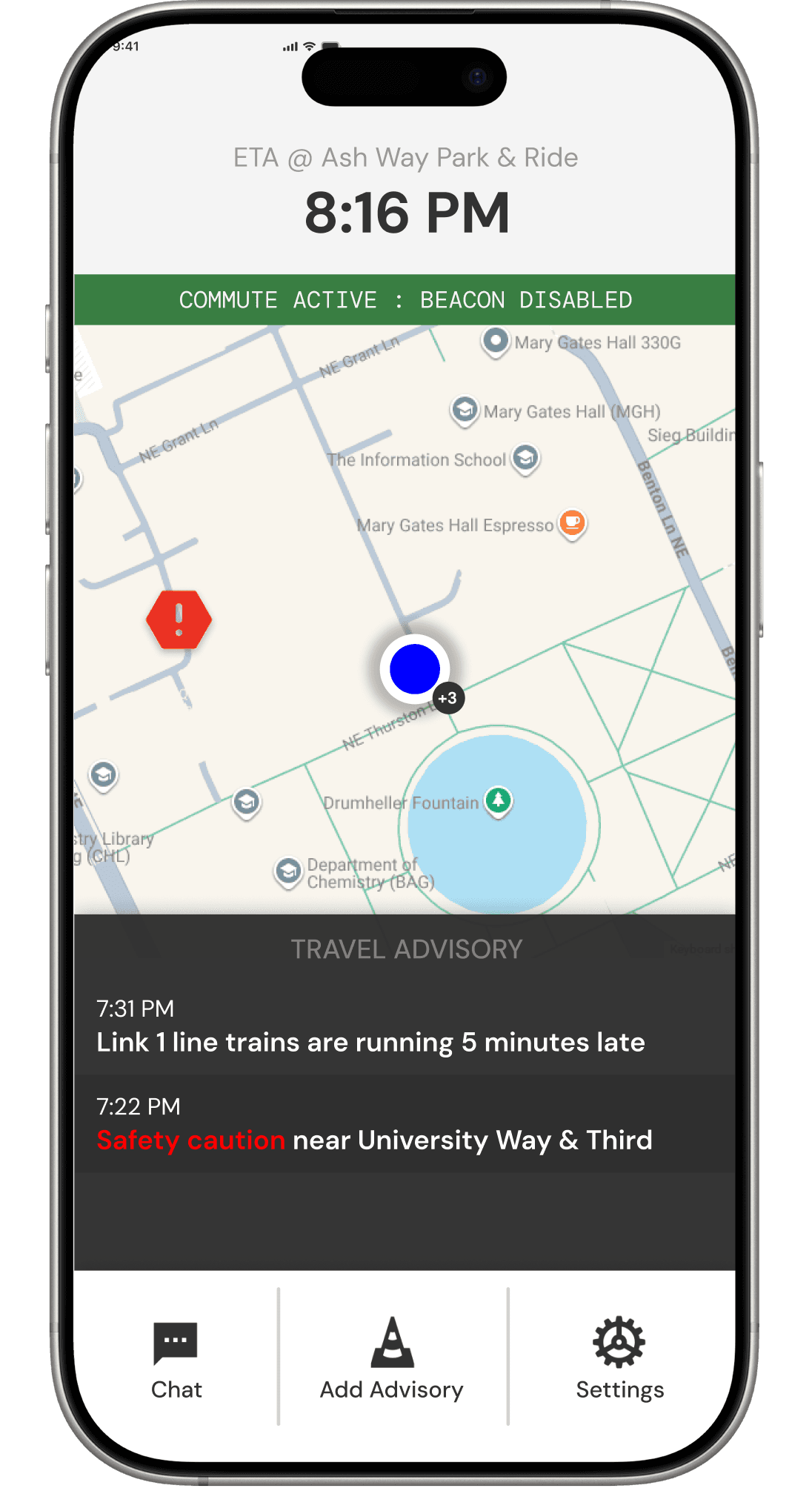
Live advisory map
Travel map actively updates with new advisories, allowing commuters to travel accordingly. Users are able to submit reports as they happen.
IDENTIFYING THE GAP
With the problem space defined, we looked at existing services to narrow down our stakeholders
Survey results revealed a clear divergence in safety needs between short-range and long-range commuter students. While short-range commuters benefit from existing resources such as UW’s
Husky Safe Trip service, long-range commuters often travel beyond its coverage.
To see where the system is failing long-range commuters, we mapped the current landscape of safety tools against commute distance.
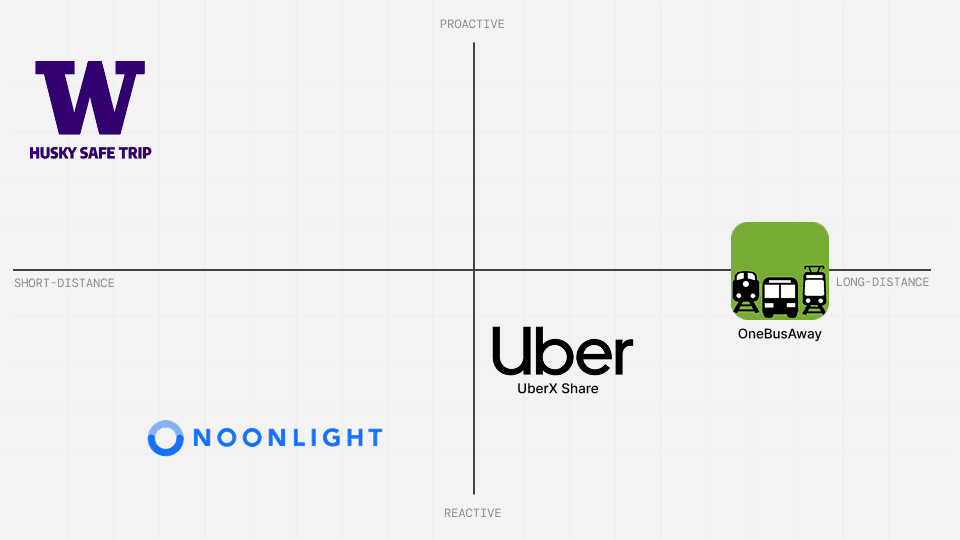
Proactive safety solutions break down for long-range, off-peak commuters
From this mapping activity, we identified our stakeholder groups and their values.
🎓
Long-distance
Commuter Students
Primary Stakeholder
Personal Safety
Privacy
Autonomy
🚃
Transit Operators
Secondary Stakeholder
Rider Safety
Efficiency
👮♂️
Campus & Transit Security
Secondary Stakeholder
Awareness
Communication
USER RESEARCH
Uncovering patterns from the data
After narrowing down on our primary stakeholder group, we created a survey and sent it to ten
participants in order to gain further insight on the daily experiences and tensions of commuter students.
We found one common theme amongst each participants' responses:
Unsafe travel conditions become a barrier that prevents commuter students from fully participating in classes, jobs,
and other campus activities.
6 out of 10 commuter students reported changing their travel plans
due to perceived unsafe conditions.
After receiving the survey responses, my team and I generated insights based off the data.
RESEARCH INSIGHTS
Social environments foster a
sense of safety
All responders travel with friends when possible or are in constant phone contact with a friend or family member.
Commute safety
decides participation in everyday activities
6 out of 10 commuters indicated regularly changing plans due to safety concerns, experiencing prior incidents.
Dim and isolated environments are often avoided if possible
Most commuters feel unsafe walking through poorly lit areas and waiting alone at stops.
DESIGN PRINCIPLES
Trust & Control
Users should be able to connect
with verified commuters while controlling what information is
shared and with whom.
Stability
Users should be able to create, sustain, and communicate with compatible commuter groups depending on the situation
Proactivity
Users should be able to make safety-related decisions without having to experience an incident first.
IDEATION
Sketching the foundation.
Once our design principles were identified, we sketched out the primary features off the app, providing us a basis for our first round of iterations.
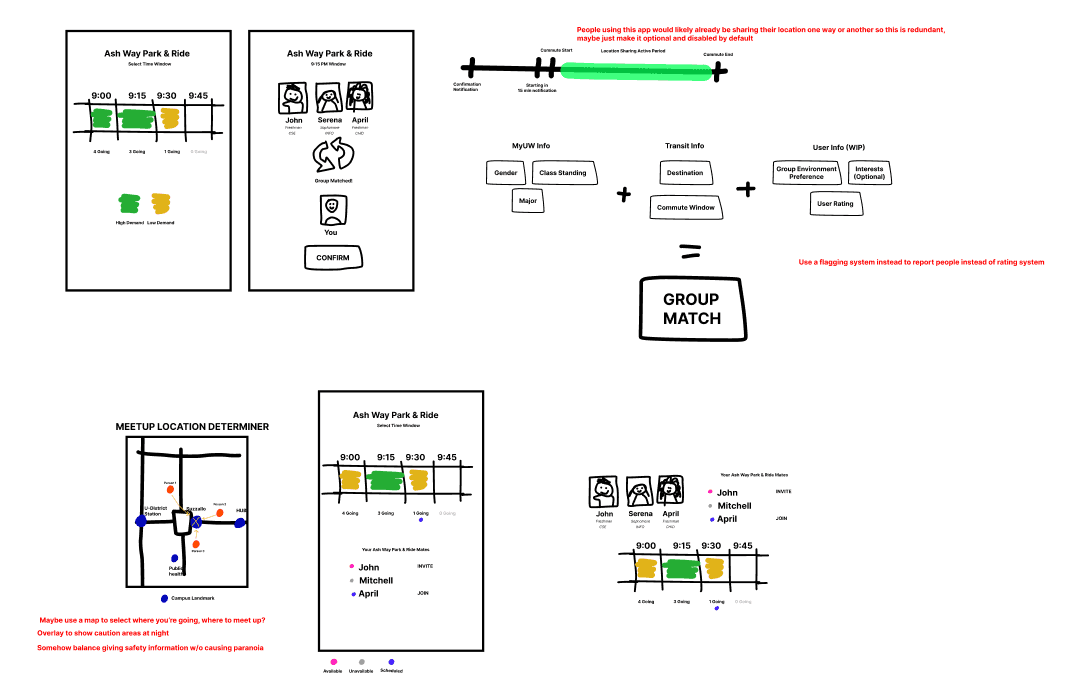
INITIAL SKETCHES
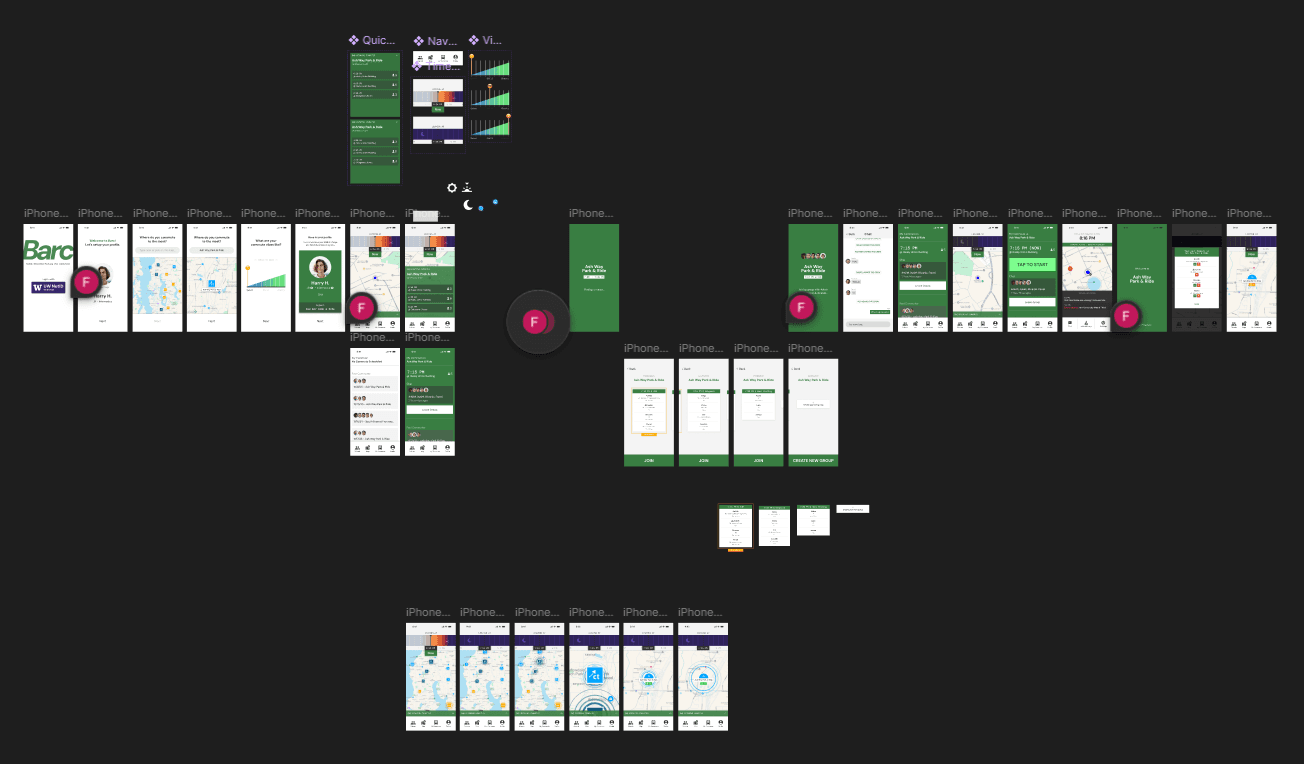
INTERFACE ITERATION
FEEDBACK & USABILITY TESTING
Listening, testing, refining.
Two participants from our screener survey were selected to give us feedback on our concept sketches
and early stage interfaces. These user-driven insights resulted in key feature development and a refined visual design and user flow.
From an accident to feature: How a sketch misinterpretation lead to our home screen design
While showing a map sketch that explained how a feature would work in the back-end, a participant thought it was the home route selector screen for our app, leading us back to the drawing board.
Design principle: Proactivity
BEFORE
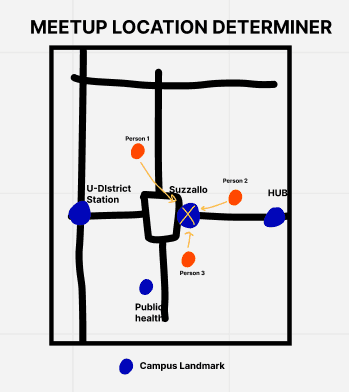
"Maybe use a map to select where you're going, where to meet up?"
AFTER
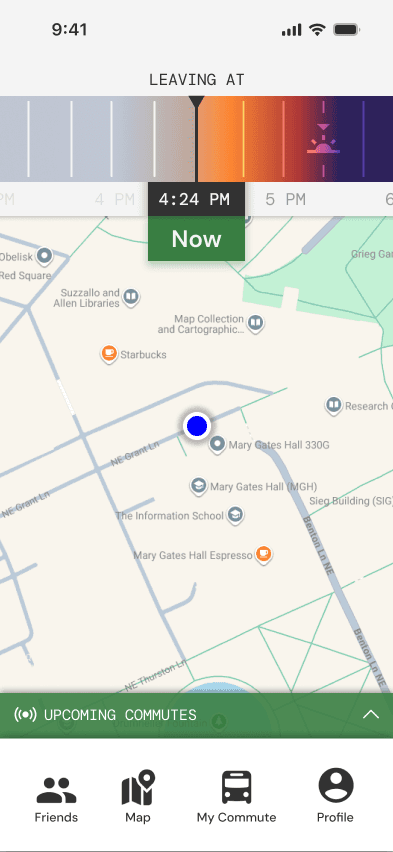
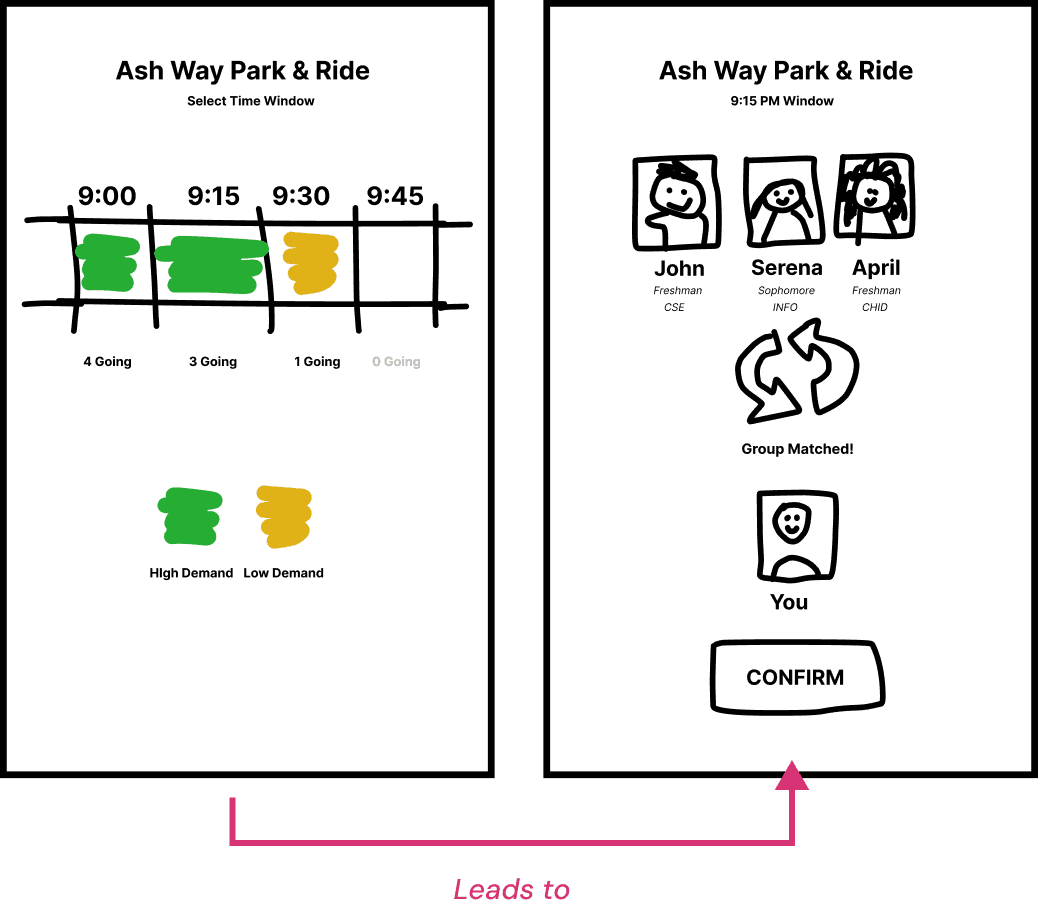
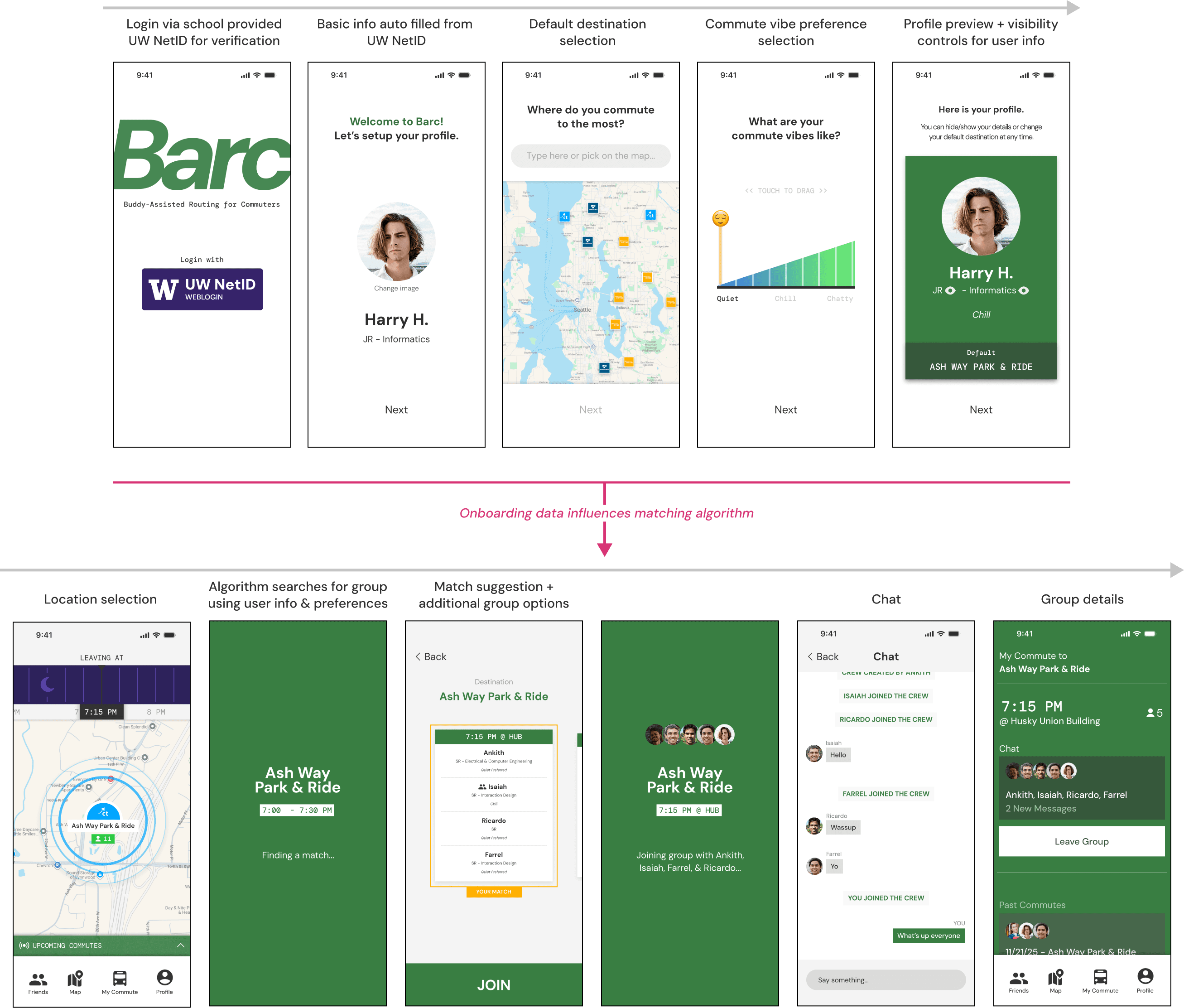
Balancing ease and privacy: Creating an automatic matching system & visibility controls
Feedback on potential misuse of our initial group selection screen led us to rethink information visibility.
To ensure safety, only verified students can log in via their UW NetID. We also implemented an algorithm to form groups based on commuter preferences and added visibility controls, keeping users safe while maintaining fast, automatic matching.
Design principles: Trust & control, Stability
BEFORE (MANUAL MATCHING)
AFTER (AUTOMATIC MATCHING)
NEXT STEPS
Scale to short-range commuters
Expanding beyond long-range commuters would unlock a larger daily-use audience, increasing engagement frequency and making the platform more viable for campus-wide rollout through integrations with services like Husky Safe Trip.
Track, test, and iterate
To evaluate the real-world impact of the design, I would track metrics such as buddy match completion rate, in-trip engagement, and reported feelings of safety before and after use. These metrics would help validate whether the platform meaningfully improves commuter confidence while informing future iterations.
REFLECTION
Learning to trust data beyond interviews
I expected interviews to drive most of our insights, but survey data revealed unexpected patterns in commuting behavior. This shifted how I approach synthesis and gave me more confidence using quantitative data to support design decisions.
Designing with motion as communication
This project changed how I think about motion in interfaces. Using Figma’s smart-animate tools helped me see motion as a signifier to to guide users, not just add polish, making interactions feel clearer and more alive, while making flows smoother.
Curious about mobile apps?
You may be interested in…

MIXED REALITY FLIGHT TRACKER
Plane(AR)
TASKS FOR ZOOKEEPERS